NEW QUESTION 57
Case Study 2 – Fabrikam Inc
Background
Fabrikam Inc. is an energy provider that operates wind and solar farms across multiple countries and regions. The company uses Microsoft Power Platform to manage asset maintenance, technician workflows, and predictive analytics.
Field technicians use canvas apps on mobile devices to capture inspection and repair data.
Operations managers use model-driven apps to monitor asset performance and maintenance history.
The company plans to enhance its platform by introducing AI-driven insights, improving reuse across applications, and establishing a formal application lifecycle management (ALM) strategy.
Current environment
Applications
Field technicians use an outdated mobile app to log maintenance activities and capture asset readings in SharePoint Online.
Operations managers use a model-driven app to review maintenance records and asset performance trends.
Development practices
Developers build and modify applications directly in the production environment.
There is NO structured ALM process.
Solutions are NOT consistently used to package or deploy application components.
Reusable components are inconsistently implemented across apps, leading to duplication.
AI integration
Fabrikam Inc. plans to actively explore generative AI usage as part of the next phase of work.
Business requirement
Application development
The outdated mobile app must be replaced with a new app that supports responsive design principles, provides full control over the UI, and allows technicians to take and upload photos directly from their mobile devices.
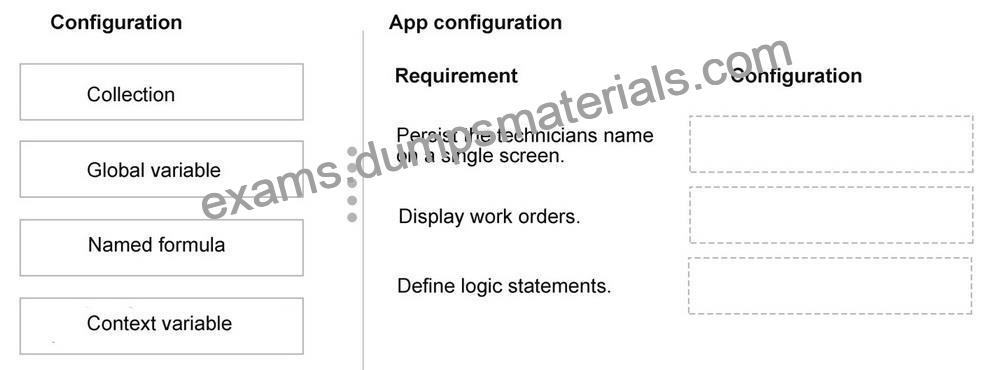
The new app for the field technicians requires the name of the technician to be persisted on the home screen only. In addition, work orders must be displayed within a gallery.
All new apps must connect to a scalable, cloud-based relational data store.
Apps must support efficient data entry for technicians in the field.
Reusable UI elements must be implemented to reduce duplication.
AI capabilities
The company requires a generative AI solution to manage customer complaint responses and create custom inspection reports that align to an existing template.
Customer complaint responses must be generated in applications and based on emails being sent to a mailbox.
Custom AI development must be minimized.
Generative AI reusability
Generative AI solutions must accept dynamic inputs to adapt to different scenarios.
Generative AI solutions must be reusable across different Power Platform services.
Extensibility
Custom UI form components must be reusable across applications.
Use of server-side custom code must be minimized where possible.
Technical requirements
Application lifecycle management (ALM)
Separate environments must be used for development, testing, and production.
Solutions must be used to package application components, segmented based on functional areas.
Managed solutions must be deployed to the production environment.
Validation must occur before deployment to production.
Data processing
Aggregated values across related rows must be displayed for reporting.
Calculations must update automatically as new data is entered. Calculation data must be limited to a maximum length of 10.
Issues
Duplicate logic exists across multiple canvas apps.
Developers frequently overwrite changes in production.
Generative AI solutions produce inconsistent outputs due to missing or inconsistent inputs.
Maintenance metrics are not consistently calculated across related rows.
Drag and Drop Question
You need to create the new app based on the requirements.
Which configurations should you use? To answer, move the appropriate configurations to the correct requirements. You may use each configuration once, more than once, or not at all. You may need to move the split bar between panes or scroll to view content.
NOTE: Each correct selection is worth one point.
Explanation:
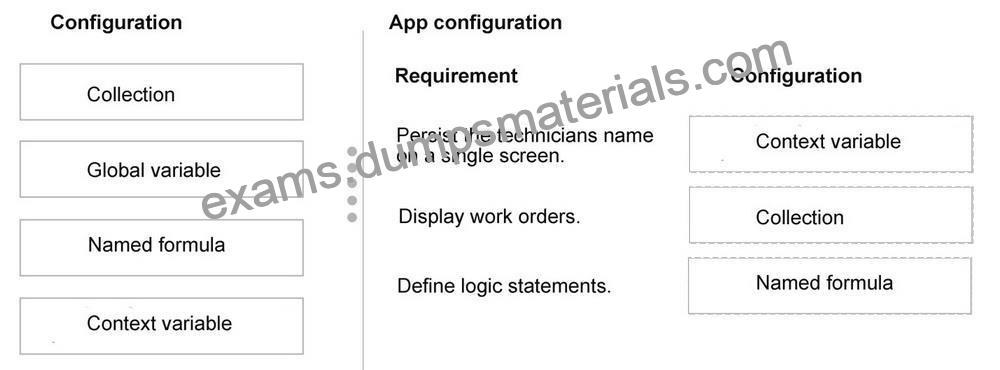
Box 1: Context variable
The new app for the field technicians requires the name of the technician to be persisted on the home screen only.
The correct feature for this requirement is a Context variable.
Screen-Level Scope: Context variables in Power Apps are explicitly designed to hold a temporary state or value that only matters on the current screen.
Isolated Data: Because the requirement explicitly states that the technician’s name only needs to be persisted on the home screen only, using a local/context variable ensures the data is isolated and does not occupy unnecessary memory across other pages or screens.
Box 2: Collection
Work orders must be displayed within a gallery.
The correct feature useful for this requirement is a Collection.
Tabular Data Storage: A collection is a specialized local variable in Power Apps explicitly designed to store multi-column data tables, arrays, or groups of records locally.
Gallery Integration: The primary purpose of a Gallery control is to display a list or table of multiple records. Setting the Items property of a gallery directly to a Collection (e.g., ClearCollect(colWorkOrders, WorkOrdersDataSource)) allows you to loop through, manipulate, and cleanly render each work order record.
Box 3: Named formula
Define logic statements.
When writing Power Fx logic inside a model-driven app (such as for Dataverse formula columns or modern commanding), the platform heavily relies on declarative, excel-like calculations.
Named formulas allow developers to define logic statements that automatically recalculate based on their dependencies, without needing manual variable management. They improve app efficiency by calculating values only when they are needed.
Scenario:
The outdated mobile app must be replaced with a new app that supports responsive design principles, provides full control over the UI, and allows technicians to take and upload photos directly from their mobile devices.
The new app for the field technicians requires the name of the technician to be persisted on the home screen only.
In addition, work orders must be displayed within a gallery.
All new apps must connect to a scalable, cloud-based relational data store.
Reference:
https://chrisworth.dev/posts/power-apps-variables-mastery-guide/